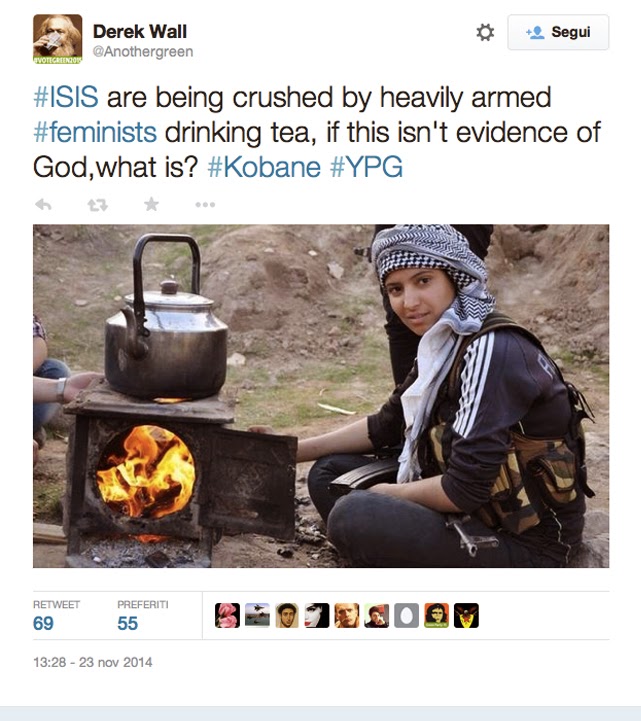
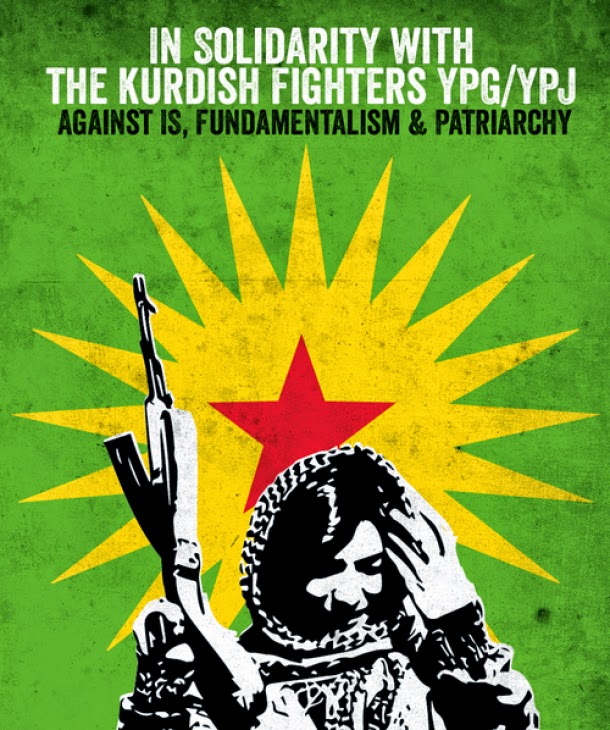
Kobane è allo stremo; oramai da molti mesi; li si gioca una battaglia che difende anche tutti noi, eppure in suo sostegno non si fa abbastanza. Come mai? Dal Kobane Reconstruction Board rilanciamo un disperato appello perché venga creato un corridoio umanitario fra la città e la confinante Turchia [dal cui governo, invece, vengono solo nuovi pericoli].
 Per aderire all'appello scrivete a reconstructkobane@gmail.com [di seguito il testo completo]. Nel frattempo la rete che sostiene la resistenza contro l'Isis sta organizzando, per il 15 settembre (anniversario del primo attacco di Isis al cantone di Kobanê), una manifestazione a Suruç, città gemella di Kobanê, a pochi chilometri dal confine siriano (colpita dal gravissimo attentato di luglio), con l'obiettivo, per le prossime settimane, di un convoglio umanitario come atto concreto della solidarietà internazionale: l'invito (a singoli attivisti, istituzioni, sindacati, partiti politici, ONG, autorità locali e internazionali) è di aiutare a creare una grande carovana internazionale per promuovere la pace e sostenere la stabilità in Siria e nelle regioni liberate dal terrorismo. La prima urgenza è appunto l’apertura del corridoio umanitario, sollecitando l’ONU che, implementando la Risoluzione 2165 del 14 Luglio 2014, art. 2, potrebbe essere in grado di garantire l’apertura di un ulteriore valico di confine (vedi anche il testo sotto all'appello in inglese).

Appeal for a “Humanitarian Corridor” / open up a corridor to Kobane
Kobane desperately needs our help to rebuild itself and for this to take place, the establishment of a humanitarian corridor between Kobane and Turkey is an urgent requirement.
As of today, July 2015, the city of Kobane, located on the Syrian-Turkish border, remains subject to the merciless attacks of ISIS. Equipped with far less sophisticated weapons and with limited resources, the people of Kobane’s unflinching determination to survive is their only real means of opposing ISIS, to hold on to their independence and to be free from this brutal violence. And this is what they have undertaken, at times supported by the US air force as part of the international coalition to resist the advance of ISIS. The price of Kobane’s resistance has been high: countless dead and injured, and an almost completely destroyed city infrastructure, which has left essential supplies of water, electricity, food and medicine in a state of collapse. And the threat from ISIS has still not been eliminated.
During the fight for Kobane, ISIS laid millions of mines to obstruct the population from returning home and to make the cultivation of agriculture on which they depend for their livelihoods impossible. Kobane is almost completely closed off from the outside world and every day it has to deal with new attacks. The only way that people can obtain essential supplies needed for their survival and protection is to go north across the Turkish border. This corridor is for the most part kept closed by the Turkish government. Turkey has provided asylum to many people from Kobane and hospital care. Nonetheless, given the scale of ISIS's war and the catastrophic situation in the city, this is by no means sufficient, especially since many of those who had fled have since returned to their destroyed city in order to rebuild it. Whilst international humanitarian aid to other regions of Syria is being provided through the Turkish border, it must also be possible for the population in Kobane to receive supplies. Only if the border with Turkey is open will the people of Kobane be able to receive all the aid and assistance which has been offered to supply, protect and rebuild their community. Reconstruction of the destroyed infrastructure will only be possible if international emergency helpers and experts are able to gain access on the ground to the cities that are in urgent need.
That is why we are calling on the Turkish government to urgently open up a corridor to Kobane to allow the city to live again and for the reconstruction to begin.
• We are also calling on all international institutions and European governments to exert their influence with the Turkish Government to this end.
• The United Nations should extend decision S/RES/2165 (2014) of 14 July 2014, Article 2, in order to guarantee an additional border crossing to Kobane. In the past, the international community, in particular the UN has been able to establish humanitarian corridors by political and diplomatic intervention.
• The opening up of the border, and the support for the reconstruction of this city, are now matters of humanitarian urgency.
Universal values such as democracy and freedom are being defended in Kobane.
First signatures: Thomas Schmidt, Lawyer, Secretary General of ELDH, Germany; Prof. Dr. Norman Paech, International Law -Germany; Dr.h.c. Hans von Sponeck, UN Assistant Secretary-General a.D. -Germany; Murat Çakır, Geschäftsführer der Rosa-Luxemburg-Foundation Hessen-Germany; Prof.Dr.med.Ulrich Gottstein, Frankfurt/Main-Germany; Prof. Dr. Elmar Altvater, Germany; Janet Biehl, Writer, Eco-Feminist -US; Sukla Sen , Peace activist, India; Emma Wallrup, Swedish, member of parliament for the Left, Sweden; Benny Gustafsson, The support comittee for Kurdistan, Sweden; Prof.dr Franco Cavalli, president of cancer fight association, former MP, Switzerland; Nina Rasmussen og Hjalte Tin , Denmark; Harem Karem, editor, Pasewan, India; Caroline Lucas, MP for Brighton Pavilion, House of Commons; Minoo Alinia, Associate Professor in Sociology, Department of Sociology, Uppsala University, Sweden; Liliane Maury Pasquier , Fderal MP and member of EC- Switzerland; Carlo Sommuruga , MP Social Democratic Party of Switzerland; Jean Zigler ,Membre du comité consultatif du Conseil droits de l'Homme des Nations Unies- Switzerland; Bernard Kouchner ,Co-Founder of DOctor without Borders and former Foreign Affairs Minister- France; Patrice Franceschi , Author of the Book `Die for Kobane` France ;Edourd Martin , MEP -France; Vittorio Agnoletto, World Social Forum International Conciel, Italy; Claudio Bisio, Actor, presenter, voice actor, comedian and writer - Italy; Luisa Morgantini, Former Vice-President of European Parliament- Italy; Rete Kurdistan ,Kurdistan Solidarty Network- Italy; Blade Nzimande : Minister of Higher Education and Traning and General Secretary of the SACP, ANC, NEC and NWC, Soth-Africa; Joyce Moloi Moropa : Member of South African Parliament (ANC), Soth-Africa' Zingiswa Losi : 2nd Deputy President of COSATU, Soth-Africa ; Jeef Radebe : Minister in the Presidency for Performance Monitoring and Evaluation (ANC), Lawyer, Former Political Prisoner, Soth-Africa; Lechesa Tsenoli: Deputy Speaker of the South African National Assembly, Former Minister of Local Government and Traditional Affairs, Soth-Africa; Celiwe Madlopha : Member: National Assembly (Parliament) Soth-Africa ; Mugwena Maluleka : general secretary of the South African Democratic Teachers Union (SADTU), Soth-Africa; Mluleki Dlelanga : National secretary of the YCLSA (Young Comunist League of South Africa; Hillary Qjukuru : Niigeria, Editor of Uharu (Freedom) Magazine based in South Africa; Adrian Williams: Member: National Assembly (Parliament) Soth-Africa; George Mashamba : SACP Central Committee Member and former Robben Island Prisoner; Che Mathloke: SACP Central Committe member and Secretary for International Affairs and General Secretary of Friends of Cuba Society in South Africa; Jeremy Cronin : SACP 1st General Deputy Secretary and Deputy Minister of Public Works, Soth-Africa; Fiona Treggana: proffesor of economy, Soth-Africa; Sabir Abu Saadia: Representative of the SPLM-N Sudan in South Africa; Vuyani Iyhali : Communist Party of Lesotho (CPL) , Soth-Africa; Inter Parliamentary Work Group in Belgium; Coordination Stop the War against Kurds, Belgium; Kurdish Institutions in Belgium: ; Info-Turk,Belgium; VREDE, Belgium; Solidarity committee with Rojava, Belgium; Union of the Socialist Women in Belgium; Belgium Immigrants Collective,Belgium; Anni Pues, Human Rights Lawyer, International Committee Scottish Green Party, UK ;Minoo Alinia, Associate Professor in Sociology, Department of Sociology, Uppsala University, Sweden; Joost Jongerden, , Assistant Professor, Wageningen University, the Netherlands; Shannon Brincat, Academic, Griffith University, Australia; Sukla Sen, peace activist, India; Abdalkareem Atteh, Phd Student, Essex University, UK; Caroline Lucas MP, Green Party of England and Wales, UK; Derek Wall, International Coordinator of the Green Party of England and Wales; UK; Kate Osamor MP, House of Commons, UK; Val Swain, Phd candidate, University of East Anglia, UK; Houzan Mahmoud, Kurdish feminist activist; Sean Hawkey, photo journalist, UK; Harem Karem, editor, Pasewan.com, UK; Isabel Kaser, PhD candidate SOAS, UK; Stephen Smellie, UNISON South Lanarkshire, Scotland' John Hunt, editor, writer; UK; Corporate Watch, UK; Julia Iglesias, Newroz Basque-Kurdish Friendship Association, Basque Country; Joe Ryan, Chair of Westminster Diocese for Peace and Justice, UK; Bob Rossi, Labour and solidarity activist, US; Thomas Schmidt, lawyer, Secretary General of ELDH ;Bob McGlynn, Neither East Nor West-NYC, US; Andreas Gavrielidis, Greek-Kurdish Solidarity, UK; Trevor Rayne Lecturer in Economics and Public Service Management & Fight Racism! Fight Imperialism! UK; Sarah Parker, human rights activist, UK; Bronwen Jones, barrister, UK; Peter Tatchell, Director, Peter Tatchell Foundation, UK; Dashty Jamal, Secretary , International Federation of Iraqi Refugees-IFIR, UK; Khatchatur I. Pilikian, Prof of Music & Art, UK; Oonagh Cousins, Film Producer, UK; Joshua Virasami, Social Justice Activist, Black Dissidents, UK; Richard Haley, Chair, Scotland Against Criminalising Communities; Scotland; Nick Hildyard, policy analyst, UK; Isil Altan, Student, Kurdish Society of Nottingham Trent University, UK; Kardo Bokani, Assistant Lecturer , University College Dublin (UCD); Ireland; Jonathan Bloch, author; UK; Azad Dewani, PhD candidate; UK; Baris Oktem, Post Graduate Sociology Department, University of Essex; UK; Campaign Against Criminalising Communities UK; Dr Meryem Kaya, Trainee doctor, Kurdish Professionals Network, UK; Tara Jaff, musician, UK; Kat Glover, IT developer, UK; Neil Taylor LL.M, PGCM, MCIPR, Lawyer and Journalist, UK; Roza Salih, Human Rights Activist (Glasgow Girl) and the Co-founder of the Scottish Solidarity with Kurdistan, UK; Jasim Ghafur, Visual Artist and Welfare Rights advisor, UK; Raoof Sofie, Accountant-UK; Tim Cooper, treasurer Nottingham Unite Community and Nottingham Kurdish Solidarity campaign, UK; Melissa Cowell, PhD student, Nottingham Kurdish Solidarity Campaign, UK; Yasin Aziz, Author, poet, UK; Penny Papadopoulou, freelance journalist, UK; National Union of Journalists (NUJ), Manchester Branch, UK.
[da un ponte per]: Il 15 settembre 2014 Isis ha lanciato la prima ingente offensiva contro il cantone di Kobanê, in Siria. La popolazione curda, guidata dalle forze di autodifesa del popolo (YPG e YPJ) ha organizzato una grande difesa contro l’attacco. La resistenza di uomini e donne all’interno di Kobanê, è stata una battaglia per la democrazia, per i diritti umani, per un futuro comune, per la legittimazione e l’uguaglianza delle donne nella società. Il supporto della Coalizione Internazionale è stato prezioso ma non sufficiente. Kobanê è stata liberata dopo 134 giorni di resistenza, ma gli attacchi non si sono fermati: tra il 25 e il 27 giugno l'ISIS ha compiuto l’ennesima strage a Kobane dove più di 200 civili, la maggior parte dei quali donne e bambini, sono stati brutalmente assassinati. Il 20 luglio un attentato suicida ha colpito in territorio turco il centro culturale Amara di Suruç, punto di riferimento della solidarietà internazionale con Kobane, provocando 32 vittime e 100 feriti tra i giovani dell’organizzazione dei giovani socialisti in procinto di partecipare alla ricostruzione della città siriana. A seguito di questo ultimo attacco la Turchia, pur mantendendo l’embargo su Kobane, ha dichiarato la propria partecipazione alla Coalizione Internazionale contro l’Isis, attuando però unicamente una politica feroce di attacco alle postazioni curde dello YPG, dello YPJ e del PKK, unici avversari in campo aperto delle bande dello Stato Islamico e contemporaneamente aprendo una campagna repressiva verso i sostenitori dei partiti di opposizione della Sinistra Turca e dei partiti filocurdi Hdp, Dbp e Dtk, arrestando piu di 1200 persone in territorio turco.
La resistenza della Rojava nonostante ciò continua e Kobane ha piu che mai necessità del sostegno internazionale. I servizi essenziali quali acqua ed elettricità, i rifornimenti di cibo e le cure sanitarie sono ai minimi livelli o addirittura inesistenti ed è necessario garantire ai rifugiati la possibilità di rientro nella propria città in modo sicuro, sostenendo la ricostruzione delle infrastrutture basilari, al fine di assicurare loro una vita dignitosa. Kobanê e la regione del Rojava sono circondate ancora oggi da Isis. L’apertura del confine con la Turchia risulta quindi fondamentale. La popolazione di Kobanê ha urgentemente bisogno di un corridoio umanitario per ricevere gli aiuti necessari al fine di proteggere, rifornire e ricostruire la propria città.
Dopo la riconquista di Kobane, le forze anti-Isis curde hanno conquistato città strategiche come Tal Abyad, Ain Issa, Sarrin, Hasaka, e continuano l’avanzata liberando villaggi verso Raqqa, capitale dello Stato Islamico in Siria. La ricostruzione di Kobane e il sostegno alla Rojava garantiscono oggi l’unico percorso possibile per una democratizzazione della Siria e dell’intera area, mentre l’obiettivo della Turchia di creare una buffer zone tra i cantoni di Kobane e Afrin, favorirà nei fatti l’avanzata delle forze jihadiste e qaediste mettendo a rischio centinaia di migliaia di vite umane. La situazione richiede una straordinaria attivazione della solidarieta internazionale.